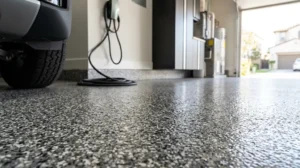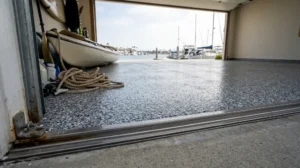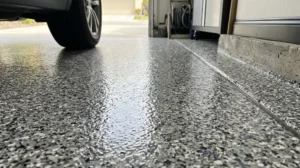
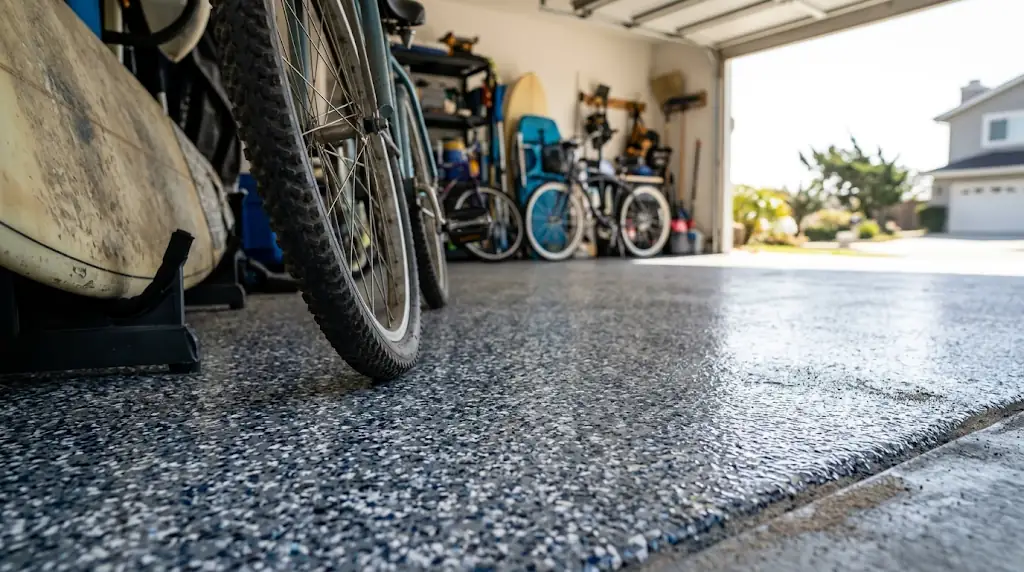
A professionally installed multi-coat epoxy floor in Huntington Beach lasts between 15 and 20 years in residential garages, while commercial installations typically provide 10 to 15 years of continuous service under heavy foot and vehicle traffic. In contrast, thin DIY epoxy paint kits fail within 1 to 3 years due to coastal vapor pressure, hot-tire delamination, and unmitigated slab alkalinity.
Epoxy Lifespan by System Type and Chemistry
Floor longevity is dictated by resin chemistry, dry film thickness (DFT), and topcoat resistance. Single-coat systems wear down rapidly, whereas multi-layer industrial builds withstand continuous mechanical abrasion.
| Coating System Configuration | Total Build Thickness | Residential Lifespan | Commercial Lifespan | Primary Failure Mechanism |
| Retail Water-Based Epoxy Paint | 2 – 4 mils DFT | 1 – 3 years | < 1 year | Hot-tire pickup, moisture blistering |
| 100% Solids Solid Color Epoxy | 12 – 16 mils DFT | 7 – 10 years | 3 – 5 years | Surface scratching, UV chalking |
| Multi-Layer Full Flake + Polyaspartic | 25 – 35 mils DFT | 15 – 20+ years | 8 – 12 years | Normal abrasive wear-through |
| Metallic Decorative Epoxy | 30 – 45 mils DFT | 10 – 15 years | 5 – 8 years | Micro-scratching, loss of gloss |
| Urethane Mortar Trowel-Down | 125 – 250 mils (1/8″–1/4″) | 20+ years | 15 – 20 years | Severe structural slab cracking |
Coastal Environmental Stressors in Huntington Beach
Coastal concrete in Huntington Beach faces distinct physical and chemical threats that do not exist in inland regions. Long-term coating survival requires engineering around these specific environmental conditions:
1. High Water Tables and Moisture Vapor Transmission (MVER)
Much of Huntington Beach—specifically neighborhoods surrounding Huntington Harbour, downtown, and low-lying coastal tracts—sits on shallow water tables with continuous subterranean hydrostatic pressure. Moisture travels upward through porous concrete via capillary action.
When vapor hits an impermeable resin coating, it condenses into liquid water and generates osmotic pressure. Without a dedicated moisture vapor barrier primer, osmotic blistering shears the resin matrix off the slab within 12 to 24 months.
2. Airborne Salt Spray and Chlorides
Huntington Beach experiences persistent marine layers and windborne salt spray. Airborne sodium chloride settles onto garage and shop concrete, penetrating microscopic fissures.
Uncoated or under-coated concrete absorbs these chlorides, initiating internal chemical corrosion and crystalline expansion (salt hydration distress). A commercial-grade, non-porous floor coating acts as a hermetic barrier, isolating the concrete slab from airborne salt degradation.
3. Solar Radiation and Coastal UV Exposure
Garages with open doors or south-facing aprons face intense Southern California ultraviolet exposure. Standard aromatic epoxies degrade under UV radiation, breaking molecular polymer chains. This results in ambering (yellowing), chalking, and brittleness within 18 months of sunlight contact.
Maximizing lifespan requires an aliphatic polyaspartic or polyurethane clear topcoat that remains 100% UV-stable throughout its operational life.
Concrete Preparation Determines 80% of Coating Lifespan
A coating does not adhere to smooth or contaminated concrete. Long-term performance depends on proper mechanical profiling and moisture verification before resin touches the floor.
Mechanical Diamond Grinding vs. Acid Etching
- Acid Etching Fails Early: Muriatic acid washes do not open the slab profile evenly, leave behind neutralizing chemical salts, and fail to remove oil or tire compounds. Acid-washed floors delaminate within two years.
- Mechanical Planetary Grinding: Commercial installations utilize heavy planetary grinders equipped with diamond-segmented tooling and industrial HEPA extractors. This process cuts through weak surface laitance to expose clean, aggregate-rich concrete.
- Surface Profile Standard: Professional installations adhere to the surface profiling guidelines established by the International Concrete Repair Institute (ICRI), grinding the concrete to an anchor profile of CSP-2 to CSP-3. This mechanical tooth allows the epoxy basecoat to physically anchor into the slab matrix.
Scientific Moisture Testing
Visual dryness does not indicate internal slab dryness. In Huntington Beach, older residential slabs poured before modern building codes often lack sub-slab vapor retarders—standards now codified under California Building Code Section 1907.
Professional contractors conduct moisture testing using in-situ relative humidity probes or calcium chloride kits. Readings exceeding 3 lbs per 1,000 sq ft / 24 hours require an epoxy moisture mitigation primer rated to withstand up to 15 to 20 lbs of hydrostatic head pressure.
Environmental Compliance: SCAQMD Rule 1113
Coating durability in Southern California must comply with strict regional air quality legislation. Huntington Beach falls under the jurisdiction of the South Coast Air Quality Management District (SCAQMD), which enforces Rule 1113.
- Rule 1113 limits volatile organic compounds (VOCs) in industrial maintenance and floor coatings to a maximum of 50 grams per liter.
- Compliant, high-longevity systems utilize 100% solids basecoats and zero-VOC polyaspartics.
- These zero-solvent formulas do not shrink, gas off, or thin out during the curing process, curing into an ultra-dense polymer network that outlasts solvent-thinned alternatives.
DIY Epoxy Kits vs. Commercial Systems: Failure Timeline
Homeowners often compare retail DIY boxes to commercial installations. The operational difference lies in resin solids, film thickness, and prep methods.
| Milestone | Hardware Store DIY Kit ($200–$400) | Commercial Multi-Coat System ($2,400–$4,500) |
| Month 1 | Clean appearance, glossy surface finish | Fully cured, rock-hard chemical shield |
| Month 6 | Dull tire tracks develop in parking bays | Zero visible wear; oil and fluids wipe off |
| Year 1 | Hot-tire delamination; coating lifts under hot tires | Zero tire peel; high impact resistance intact |
| Year 2 | Flaking, peeling, moisture blistering near door | Gloss retained; clear topcoat resists UV exposure |
| Year 5 | Complete coating failure; exposed pitted concrete | Floor remains structurally sound and vibrant |
| Year 10 | Multiple failed patch jobs; needs diamond grind | High-traffic zones show minor sheen softening |
| Year 20 | Slab damage from unprotected exposure | Base layer intact; optional topcoat buff restores floor |
Routine Maintenance to Maximize System Lifespan
Commercial-grade epoxy does not require waxing or aggressive maintenance. Follow these simple practices to reach a 20-year operational life:
- Sweep Coastal Sand Regularly: Ocean grit and windblown sand act like sandpaper under foot and vehicle traffic. Dry sweep or dust-mop weekly to prevent micro-abrasions.
- Use pH-Neutral Cleaners: Never clean epoxy with acidic solutions, citrus degreasers, or vinegar, which degrade clear gloss coats. Use warm water mixed with a small amount of pH-neutral cleaner or simple ammonia.
- Wipe Fluid Spills Promptly: While chemical-grade polyaspartic coatings resist brake fluid, transmission oils, and battery acids, leaving harsh solvents pooled on the surface for weeks can dull high-gloss finishes.
- Use Soft Rubber Tires and Pads: Heavy jack stands or metal-wheeled shop equipment should rest on protective rubber pads or plywood to prevent point-load gouging.
Regional Service Lifespan Performance
Coastal conditions affect installations differently across neighboring coastal and inland Orange County municipalities:
- Huntington Beach, CA: 15–20 year life expectancy with dedicated moisture-blocking primer and UV polyaspartic topcoat.
- Newport Beach, CA: Coastal salinity requires 100% solids primers to prevent salt air crystallization under the coating.
- Costa Mesa, CA: Moderate humidity; ideal conditions for rapid curing and extended 18+ year residential life cycles.
- Irvine, CA: Higher summer heat cycles demand thermal-shock-resistant polyaspartic clear coats to stop hot-tire pickup.
- Fountain Valley, CA: Stable suburban ground slabs yield maximum 20+ year lifespans when diamond-ground to CSP-2.
- Seal Beach, CA: Elevated coastal water tables require commercial in-situ moisture testing before coating application.
- Long Beach, CA: High commercial traffic and marine air demand high-mil flake or urethane mortar installations.
Maximize the Lifespan of Your Concrete Floors
Achieving two decades of performance from an epoxy floor requires commercial mechanical surface preparation, accurate moisture testing, and heavy-duty, SCAQMD-compliant resin chemistry. Huntington Beach Epoxy Floors installs industrial-grade epoxy and polyaspartic systems built specifically to resist coastal Huntington Beach moisture, hot tires, and salt air corrosion. Schedule your on-site concrete inspection and request a detailed estimate through our contact page.