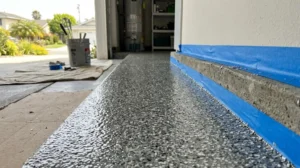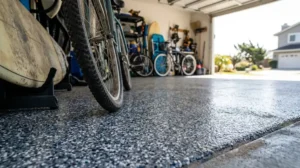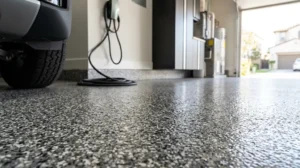
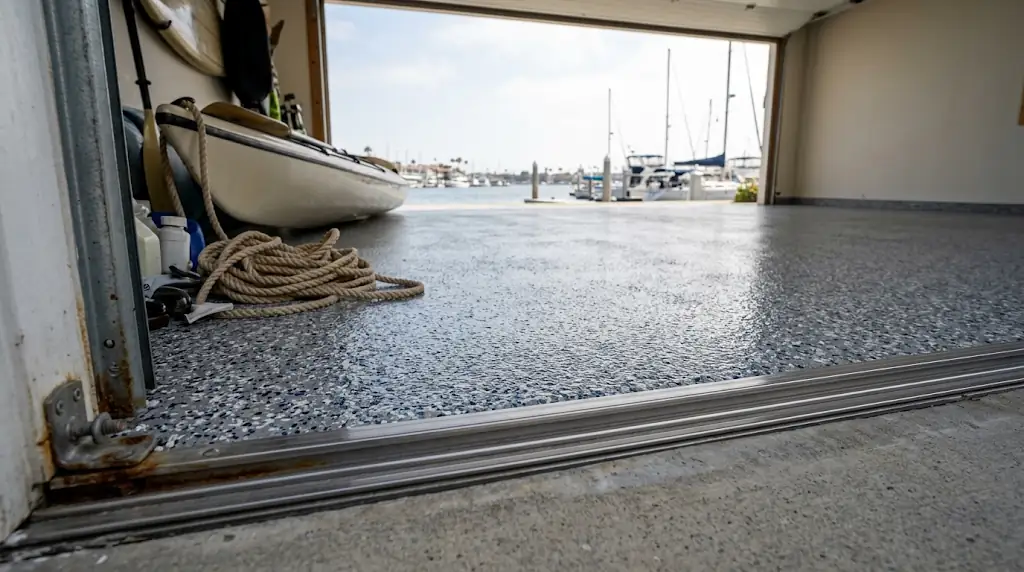
Yes, professional epoxy and polyaspartic flooring easily survives the salty coastal air in Newport Beach because the fully cured polymer matrix creates a non-porous, airtight barrier that blocks airborne chlorides and ocean moisture. Unlike bare, porous concrete that absorbs airborne salt and spalls over time, an industrial multi-coat system completely seals the slab, preventing salt crystal expansion, chemical pitting, and moisture degradation for 15 to 20 years.
How Salt Air and Marine Moisture Destroy Unprotected Concrete
Concrete is a porous, capillary network that absorbs atmospheric gases, moisture, and minerals. Newport Beach properties—particularly those along the Balboa Peninsula, Balboa Island, Newport Coast, and Corona del Mar—face continuous exposure to ocean winds, heavy marine layers, and airborne saltwater mist.
When left uncoated or sealed only with weak retail sealers, concrete experiences accelerated physical and chemical breakdown:
- Chloride Ion Penetration: Airborne salt carries dissolved sodium chloride deep into the open concrete pores. Once inside, chloride ions attack the alkaline passivation layer around steel reinforcement bars (rebar), triggering rapid rust, internal expansion, and catastrophic slab cracking.
- Salt Hydration Distress (Subflorescence): Dissolved ocean salts penetrate micro-pores and crystallize as moisture evaporates. When humidity rises during the coastal night, the crystals hydrate, re-expand, and generate internal hydraulic pressures exceeding 2,000 PSI, crumbling concrete from the inside out.
- Efflorescence and Surface Chalking: Soluble salts migrate to the surface via capillary action, depositing a white, powdery residue (calcium carbonate) that destroys paint bonds, erodes concrete paste, and leaves behind pitted, rough patches.
- Tire Transfer of Ocean Brine: Vehicles returning from Pacific Coast Highway or oceanfront access roads carry corrosive saltwater and fine beach grit into garages. Direct tire contact grinds ocean brine deep into unprotected slabs.
Coastal Durability: Bare Concrete vs. Coated Systems
Applying a high-performance commercial floor coating changes the structural profile of the concrete slab. The table below details how different surface finishes hold up against marine air and coastal exposure over time:
| Floor Surface System | Resistance to Salt Air & Chlorides | Water & Moisture Absorption | Chemical & Acid Resistance | Hot-Tire Salt Grinding Resistance | Expected Lifespan in Coastal Zones |
| Bare / Unsealed Concrete | None (Absorbs salt into pores) | High (Continuous capillary pull) | Extremely Poor (Stains & pits) | None (Accelerates surface spalling) | Progressive degradation |
| Clear Acrylic Penetrating Sealer | Low (Breaks down under UV/salt) | Moderate (Wears off quickly) | Poor (Attacked by motor oils) | Low (Tears off under warm tires) | 6 – 18 Months |
| DIY Water-Based Epoxy Paint | Low (Thin, porous 2–4 mil film) | High (Prone to osmotic blisters) | Low (Softens against solvents) | Very Poor (Hot-tire delamination) | 1 – 2 Years |
| 100% Solids Industrial Epoxy | Maximum (Impermeable barrier) | Zero (Non-porous chemical crosslink) | High (Resists salts, oils, fuel) | High (Requires UV clear topcoat) | 10 – 15 Years |
| Full Flake Multi-Coat + Polyaspartic | Absolute (Hermetic shield) | Zero (Completely waterproof) | Maximum (Industrial chemical grade) | Maximum (Zero hot-tire bonding) | 15 – 20+ Years |
The Chemistry Behind Salt-Resistant Floor Coatings
Commercial floor coatings survive marine environments because they cure through an irreversible exothermic chemical reaction rather than air-drying:
1. Cross-Linked Polymer Matrix
A 100% solids epoxy basecoat cross-links into a tightly knit, high-density thermoset plastic polymer. This molecular structure has zero open pores, making it chemically impossible for sodium chloride ions, ocean mist, or standing saltwater to penetrate into the concrete below.
2. Polyaspartic Aliphatic Polyurea Topcoats
Epoxy alone can yellow when exposed to direct sunlight coming through open garage bay doors. Professional coastal systems add an aliphatic polyaspartic clear topcoat. Aliphatic polyaspartics offer superior chemical inertness, total UV stability, and high surface hardness (Shore D hardness of 80+), ensuring salt crystals do not scratch or dull the glossy protective finish.
3. Impervious to Coastal Road Chemicals
Oceanfront vehicles track in a destructive mixture of sea spray, marine fuel exhaust, road grit, and brackish mud. A commercial polyaspartic topcoat resists automotive fluids, battery acids, and corrosive ocean brines, allowing dirt and saltwater deposits to be rinsed off with a standard garden hose.
Newport Beach Environmental and Code Compliance Factors
Protecting coastal properties requires engineering systems around localized geological conditions and regional building regulations:
High Water Tables and Vapor Retarder Mandates
Properties close to Newport Harbor or coastal estuaries sit just feet above sea level. Hydrostatic pressure forces groundwater vapor upward through older garage slabs poured without continuous underslab vapor retarders. Modern construction adheres to moisture barrier mandates outlined in California Building Code Section 1907.
On older slabs lacking modern sub-slab barriers, unmitigated moisture vapor pushes unprimed coatings off the concrete. Installations in Newport Beach require scientific moisture testing and commercial moisture-mitigating epoxy primers rated to resist up to 15 to 20 pounds of hydrostatic moisture vapor pressure.
SCAQMD Rule 1113 Environmental Standards
All coatings installed in Newport Beach must strictly conform to clean-air regulations enforced by the South Coast Air Quality Management District (SCAQMD). Under Rule 1113, architectural floor coatings cannot exceed 50 grams of Volatile Organic Compounds (VOCs) per liter.
Compliant industrial systems rely on 100% solids epoxies and solvent-free polyaspartics. Because these systems contain zero evaporating solvent fillers, they cure at 100% volume without shrinking, pinholing, or outgassing offensive chemical fumes into attached waterfront homes.
Critical Installation Steps for Coastal Adhesion
Coating survival along the coast is determined by mechanical surface preparation before any resin touches the slab, adhering to guidelines set by the International Concrete Repair Institute (ICRI):
- Diamond Grinding Over Acid Etching: Acid etching cannot neutralize coastal salts or open tight concrete pores. Technicians grind the entire surface with heavy rotary diamond grinders to eliminate salt-damaged concrete laitance, opening the slab to an ICRI Concrete Surface Profile of CSP-2 to CSP-3.
- HEPA Dust Containment: Grinding machinery is connected directly to industrial HEPA vacuums, containing crystalline silica dust and micro-particulates safely during prep.
- Moisture-Vapor Primer Coat: A specialized 100% solids moisture barrier epoxy penetrates into the diamond-ground concrete, bonding mechanically into the slab pores and preventing groundwater moisture vapor from breaking the bond.
- Full-Broadcast Vinyl Flake Bed: Color flakes are broadcast across the wet base until total saturation. This 30-mil flake layer builds impact resistance, provides slip protection against wet coastal feet, and bridges micro-hairline concrete fractures.
- Aliphatic Protective Seal: Technicians apply a clear polyaspartic topcoat that locks down the flake matrix, creating an impenetrable chemical barrier against salt spray, hot vehicle tires, and ocean moisture.
Routine Maintenance in Coastal Environments
Epoxy floors in coastal zones require minimal upkeep to retain their finish and durability:
- Rinse Away Salt Crust: Hose down or damp-mop the floor every few weeks to clear surface salt residue tracked in from oceanfront roads.
- Sweep Beach Sand: Ocean sand is abrasive. Regular dust-mopping prevents fine sand from acting like liquid sandpaper under moving vehicle tires.
- Use Neutral Cleaners: Wash with clean water and a pH-neutral cleaner. Avoid bleach, harsh acids, or vinegar, which break down clear protective gloss coats over time.
Regional Coastal and Inland Service Areas
Our commercial surface prep, moisture remediation, and coating systems are built specifically for Southern California properties across our service territory:
- Newport Beach, CA: Salt-air resistant garage systems, custom showroom finishes, and moisture-blocking primers.
- Huntington Beach, CA: Coastal garage flake floors, marine moisture mitigation, and industrial shop coatings.
- Seal Beach, CA: High-water-table slab protection, salt-resistant concrete overlays, and residential garages.
- Long Beach, CA: Heavy-duty commercial epoxy, multi-family common areas, and high-build flake coatings.
- Costa Mesa, CA: Multi-car residential garage coatings, light industrial spaces, and custom workshop finishes.
- Irvine, CA: High-heat resistant polyaspartic coatings, EV-ready garage floors, and crack remediation.
- Fountain Valley, CA: Full-flake garage floor systems, concrete surface restoration, and residential shop floors.
Shield Your Newport Beach Garage from Coastal Degradation
Protecting concrete from coastal salt air requires industrial surface preparation, proven moisture barrier primers, and zero-VOC polyaspartic topcoats. Huntington Beach Epoxy Floors engineers multi-layer floor coating systems designed specifically to withstand Newport Beach marine humidity, salty coastal winds, and heavy automotive traffic. Schedule a comprehensive slab evaluation and request an itemized estimate through our contact page.