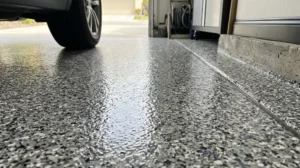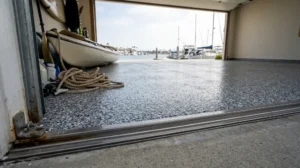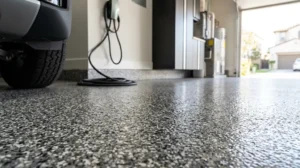
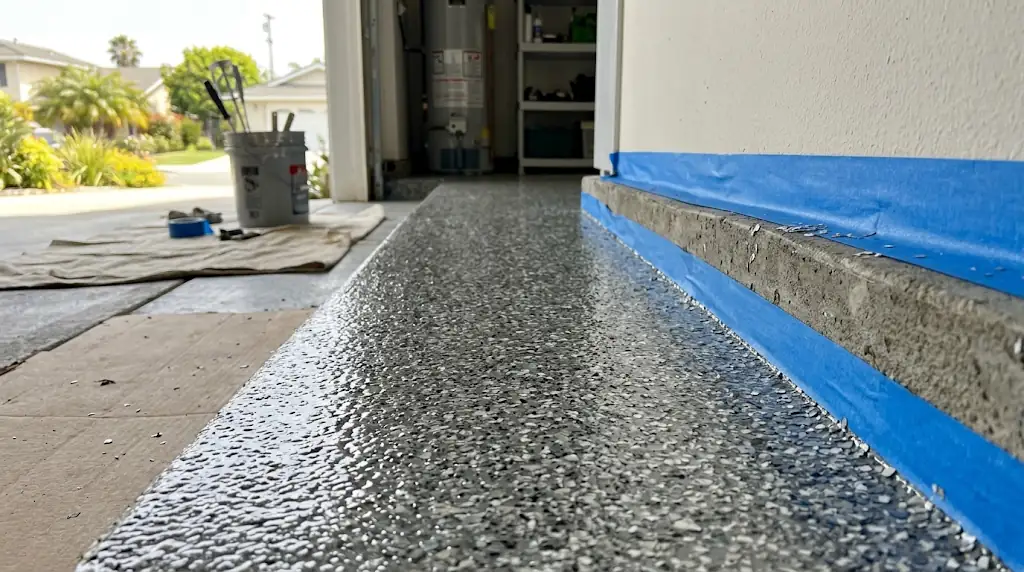
Installing a professional multi-layer epoxy floor in a standard Costa Mesa residential garage takes one to two days of on-site labor, followed by 24 to 48 hours of curing before vehicle parking. Fast-curing polyaspartic hybrid systems allow homeowners to walk on the floor within 6 to 8 hours of topcoat completion, whereas commercial spaces or severely damaged slabs requiring deep concrete restoration take three to four days.
Detailed Epoxy Installation Timeline: Step-by-Step
A durable industrial-grade concrete floor requires precise multi-phase chemistry. The installation timeline breaks down into structured operational phases:
| Phase / Day | Operational Step | Duration | Critical Objective |
| Day 1: Morning | Mechanical Surface Grinding | 2 – 4 Hours | Diamond grind concrete to ICRI CSP-2/CSP-3 profile; HEPA dust extraction. |
| Day 1: Midday | Crack Chasing & Structural Patching | 1 – 2 Hours | Fill joints, fractures, and spalls using fast-cure polyurea menders. |
| Day 1: Afternoon | Basecoat & Flake Broadcast | 2 – 3 Hours | Apply 100% solids epoxy base; broadcast vinyl color flakes to total rejection. |
| Overnight | Chemical Cross-Linking | 10 – 14 Hours | Epoxy basecoat locks mechanically into slab pores and chemically cures. |
| Day 2: Morning | Flake Scraping & Surface Reclamation | 1 – 2 Hours | Multi-directional blade scraping to flatten flakes; HEPA vacuum excess chips. |
| Day 2: Midday | Aliphatic Polyaspartic Clear Topcoat | 2 – 3 Hours | Squeegee and back-roll clear polyaspartic coat to encapsulate flakes. |
| Day 2: Afternoon | Initial Chemical Curing | 4 – 8 Hours | Surface cures tack-free; zero outgassing. |
Return-to-Service Milestones
Total project time involves both active on-site installation and passive chemical curing. Premature use damages uncured polymers and invalidates performance warranties.
- Light Foot Traffic (6 – 8 Hours Post-Topcoat): Homeowners can walk across the floor in socks or clean rubber-soled shoes to access water heaters, storage cabinets, or laundry hookups.
- Heavy Storage and Items Returned (24 Hours Post-Topcoat): Tool chests, workbenches, rolling carts, and heavy storage bins can be moved back into the garage. Heavy items should be placed directly down rather than dragged across the fresh seal.
- Full Automotive Traffic and Parking (24 – 48 Hours Post-Topcoat): Tires can safely drive and park on the surface without risk of hot-tire bonding or imprint delamination.
- Complete Chemical Cure (7 Days Post-Topcoat): The polymer matrix reaches maximum cross-link density, achieving full chemical resistance against brake fluids, transmission oils, battery acid, and coastal wash-down chemicals.
Project Turnaround Times by Garage and Facility Size
Surface area dictates the time required for diamond profiling, hand edge-grinding, material mixing, and mechanical application:
| Facility or Space Type | Total Square Footage | Active On-Site Installation Time | Total Project Window (Start to Parking) |
| 1-Car Residential Garage | 200 – 250 sq ft | 1 Full Day | 36 – 48 Hours |
| 2-Car Residential Garage | 400 – 500 sq ft | 1 – 2 Days | 48 – 72 Hours |
| 3-Car Residential Garage | 600 – 800 sq ft | 2 Days | 48 – 72 Hours |
| Commercial Retail / Light Industrial | 1,000 – 3,000 sq ft | 2 – 3 Days | 72 – 96 Hours |
| Large Industrial Warehouse | 5,000+ sq ft | 3 – 5 Days | 4 – 6 Days |
Variables That Add Time to an Installation
While standard slabs follow a predictable two-day schedule, concrete defects and environmental conditions can extend the turnaround time:
1. Concrete Moisture Vapor Transmission (MVER)
Costa Mesa features high subterranean water tables, particularly in neighborhoods along the Santa Ana River basin and low-lying tracts south of the I-405. Moisture vapor escaping through unsealed slabs must be addressed to prevent osmotic delamination.
If calcium chloride or relative humidity testing indicates moisture vapor emissions exceeding 3 lbs per 1,000 sq ft over 24 hours, technicians must apply a dedicated moisture-mitigating epoxy primer. This specialized barrier requires a dedicated 12-hour cure cycle before the decorative basecoat and flake layer can be broadcast, adding one full day to the total project timeline.
2. Extensive Concrete Restoration and Joint Repair
Slabs with settled joints, wide seismic fractures, or severe chemical pitting require mechanical chasing with diamond blades and rebuilding with rapid-setting structural epoxy mortar. Extensive slab rebuilding adds two to four hours of active preparation before prime coats can be rolled.
3. Removal of Previous Coatings or Mastic
Floors coated with failing retail DIY water-based paint, tile mastic, or acrylic sealers require aggressive PCD (polycrystalline diamond) scraping passes prior to surface profiling. Stripping thick, failed coatings adds half a day of heavy diamond grinding to the front end of the project.
Why Professional Installations Cure Faster Than DIY Kits
Homeowners comparing commercial installations to store-bought boxed kits frequently misunderstand curing dynamics. Retail DIY products take significantly longer to reach full vehicle readiness despite yielding a vastly thinner coating film.
| Performance Metric | Retail Water-Based DIY Kit | Commercial Hybrid Polyaspartic System |
| Mechanical Preparation Time | 1 – 2 Hours (Acid wash only) | 3 – 5 Hours (Industrial diamond planetary grinding) |
| Basecoat Cure to Next Stage | 16 – 24 Hours | 10 – 14 Hours |
| Safe for Light Foot Traffic | 24 Hours | 6 – 8 Hours |
| Safe for Full Vehicle Parking | 7 to 10 Days | 24 to 48 Hours |
| Total Cured Thickness | 2 – 4 mils dry film | 25 – 35 mils dry film |
| Chemical Bonding Mechanism | Evaporative drying (Water/Solvent) | Exothermic chemical cross-linking |
DIY kits rely on water or solvent evaporation, leaving a fragile film that stays soft and vulnerable to hot-tire damage for over a week. Professional systems cure through an irreversible chemical cross-link reaction that builds maximum tensile strength rapidly, allowing vehicles to return to the garage within two days.
Costa Mesa Climate and Code Considerations
Regional environmental conditions and regulatory mandates influence concrete coating timelines and application protocols:
Marine Layer Humidity and Temperature Cycles
Costa Mesa experiences regular morning coastal fog (“marine layer”) followed by dry, sunny afternoons. Professional installers monitor surface temperatures and the ambient dew point to ensure concrete slabs sit at least 5°F above the dew point before applying resin. This eliminates the risk of amine blush or pinhole entrapment caused by ambient condensation.
Regional Environmental Compliance: SCAQMD Rule 1113
All resin formulations applied in Costa Mesa must adhere to the stringent low-VOC thresholds enforced by the South Coast Air Quality Management District (SCAQMD) under Rule 1113.
- Floor coatings are capped at a maximum of 50 grams of VOCs per liter.
- Compliant 100% solids epoxies and solvent-free polyaspartics emit zero hazardous air pollutants.
- Fast curing without toxic solvent fumes allows installations in attached garages without displacing homeowners from their living quarters.
Slab Vapor Barrier Standards
Modern residential builds in Costa Mesa must conform to moisture vapor barrier specifications outlined in California Building Code Section 1907. Older post-war Costa Mesa tract homes often lack sub-slab vapor retarders, making upfront moisture profiling an essential preliminary step during project scheduling.
Surface Preparation Protocols
Achieving rapid, permanent adhesion relies on standardized surface profiling defined by the International Concrete Repair Institute (ICRI):
- Diamond Grinding to CSP-2 / CSP-3: Grinders cut open the concrete paste, eliminating dirt, oil, and laitance while creating micro-ridges that accept high-solids resin basecoats.
- Integrated HEPA Extraction: Industrial dust collectors operate continuously during grinding, maintaining a dust-free environment inside the home and neighborhood.
- Vacuum Sweeping and Tack Wiping: Technicians remove microscopic particulates before resin application, ensuring uninterrupted chemical adhesion across the entire concrete footprint.
Regional Service Coverage Across Orange County
Fast, professional installation timelines are maintained across our primary service communities:
- Costa Mesa, CA: Fast-cure garage systems, commercial workshop floors, and light industrial coatings.
- Huntington Beach, CA: Coastal moisture-mitigation epoxy installations and multi-coat flake systems.
- Newport Beach, CA: Custom showroom finishes, metallic coatings, and rapid polyaspartic garage floors.
- Irvine, CA: High-traffic garage floors, EV-ready coatings, and HOA-compliant rapid turnarounds.
- Fountain Valley, CA: Heavy-duty flake systems, slab restorations, and residential garage overlays.
- Seal Beach, CA: Marine moisture barriers, non-slip patio coatings, and garage resurfacing.
- Long Beach, CA: Commercial warehouse epoxy, retail flooring, and residential multi-car garages.
Schedule Your Costa Mesa Garage Transformation
Proper scheduling ensures a fast installation, professional surface profiling, and rapid return-to-service without sacrificing industrial durability. Huntington Beach Epoxy Floors delivers heavy-duty, SCAQMD-compliant epoxy and polyaspartic systems designed to get your garage back in service in as little as 24 to 48 hours. Request an on-site concrete evaluation and receive a detailed project timeline through our contact page.